Nature of Go
| Active period | From the Zhou Dynasty to present |
| Type | Board game |
| Number of players | Two players (Black and White) |
| Complexity | Very high |
| Strategy component | Very high |
| Game duration | Several minutes to several days |
| Luck factor | No luck involved |
| Required skills | Strategy, memory, observation, judgment, calculation |
A Brief Talk on Go:
Go is said to have been invented around 2300 BCE by Emperor Yao, to cultivate his son Danzhu's temperament, who was arrogant, impulsive, and unruly.
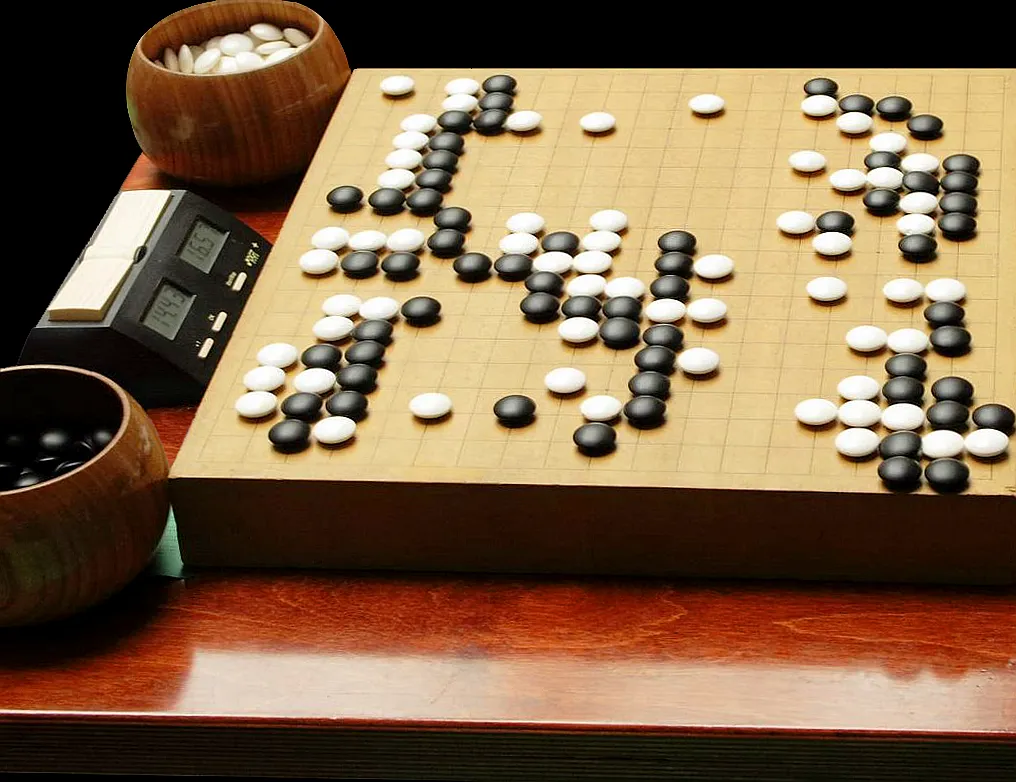
Go involves two types of stones, black and white, with the player holding the black stones moving first. The opponents alternately place their stones on the intersections of a 19x19 line grid. Once a stone is placed, it cannot be moved. The game involves capturing territory and stones, with the winner determined by the size of the territory captured.
The rules of Go are simple and elegant, but the gameplay is infinitely variable. Mastery of the game requires extensive practice and study. Chess master Emanuel Lasker praised, "If there are intelligent beings in the universe, they almost certainly play Go." Meanwhile, Go is considered one of the most complex board games in the world, with its complexity proven to be PSPACE-hard by Robertson and Munro in 1978.
As of mid-2008, there are over forty million players worldwide, most of whom are in East Asia. By the end of 2020, the International Go Federation has 77 member countries and 5 association members.
Modern Go:
After the Meiji Restoration, go players, losing support from the shogunate, began seeking new livelihoods, leading to the emergence of newspaper go tournaments and the modern ranking system, and the establishment of a nationwide Japan Go Association. In the Showa era, Go Seigen and Kitani Minoru initiated the "New Fuseki" movement, starting the era of modern Go. Subsequently, Japan's Go scene produced many top-class players like Sakata Eio, Fujisawa Hideyuki, Takagawa Kaku, and later figures like Otake Hideo, Ishida Yoshio, Takemiya Masaki, Kobayashi Koichi.
In 1989, Cho Hunhyun of Korea won the first Ing Cup World Go Championship, sparking a Go craze in Korea. Subsequently, a large number of world Go tournaments emerged. Among these tournaments, Lee Changho emerged as the top player in the Go world. After 2006, Lee Changho's performance declined, and new forces like Lee Sedol and Gu Li began to challenge him, marking an era dominated by Gu Li and Lee Sedol.
In the 2010s, many Chinese Go players rose to prominence, with Jiang Weijie, Fan Tingyu, Shi Yue, Mi Yuting, Chen Yaoye, Zhou Ruiyang, and Tan Xiao winning world championship titles.
Go Culture:
Throughout its thousands of years of history, Go has developed numerous terms. Some have entered common parlance, such as "endgame". Almost every move in Go has a specific term, allowing for entire sequences to be described in text. For example, the phrase "Black occupies the star point in the upper right corner, White approaches with a small knight's move, Black pincers with a two-space high, White jumps one space, Black follows the jump, White approaches the corner with a small knight's move, Black blocks at 3-3..." vividly describes a common opening sequence using Go terminology. Common terms include:
- Atari: When a stone has only one liberty, it's in atari. Also known as "to atari".
- Liberties: The empty points directly adjacent to a stone. A single stone cannot have more than four liberties, but a group of connected stones can have more. Playing on the opponent's liberties to threaten is called "putting pressure".
- Capture: Stones without liberties are captured and removed from the board. Capturing opponent's stones is called "capturing".
- Points: The empty intersections enclosed by one's stones are called "points".
- Territory: The total of the points enclosed by living stones and the stones themselves is called "territory".
- Space: The area enclosed by stones.
- Ko: A situation where both players can capture back and forth. Go rules dictate that during a ko fight, the player who has just had a stone captured cannot immediately recapture but must make a play elsewhere (ko threat) before recapturing.